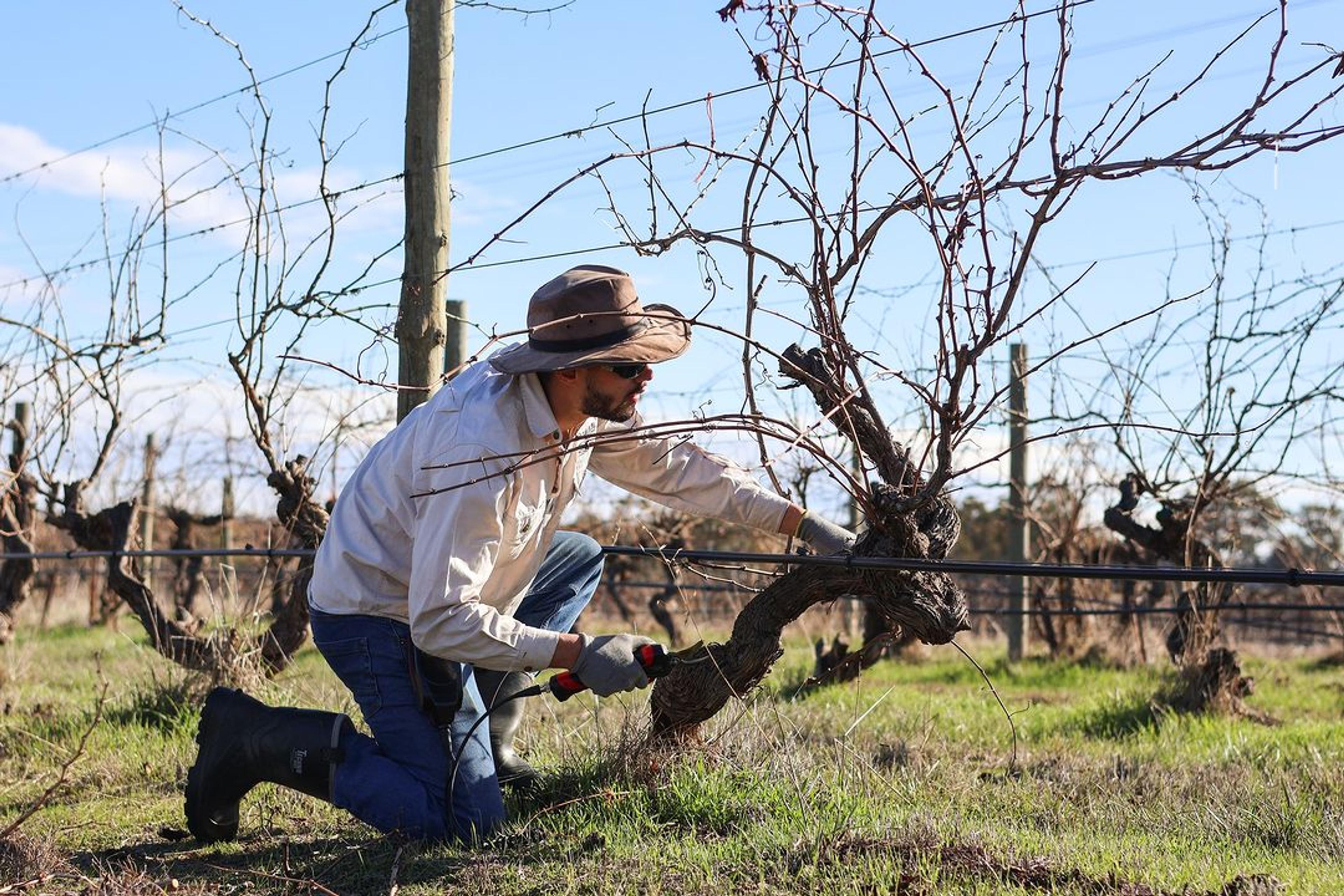
Driving around the Clare Valley and the Barossa for a week is almost like a step back in time, coming as you do across scores of vineyards that were planted in the 19th Century. And all of them on own roots, for phylloxera, mercifully, has yet to invade South Australia, although there is some of it in neighbouring Victoria. The absence of the dreaded aphid has allowed these ancient vines not just to survive but to thrive.
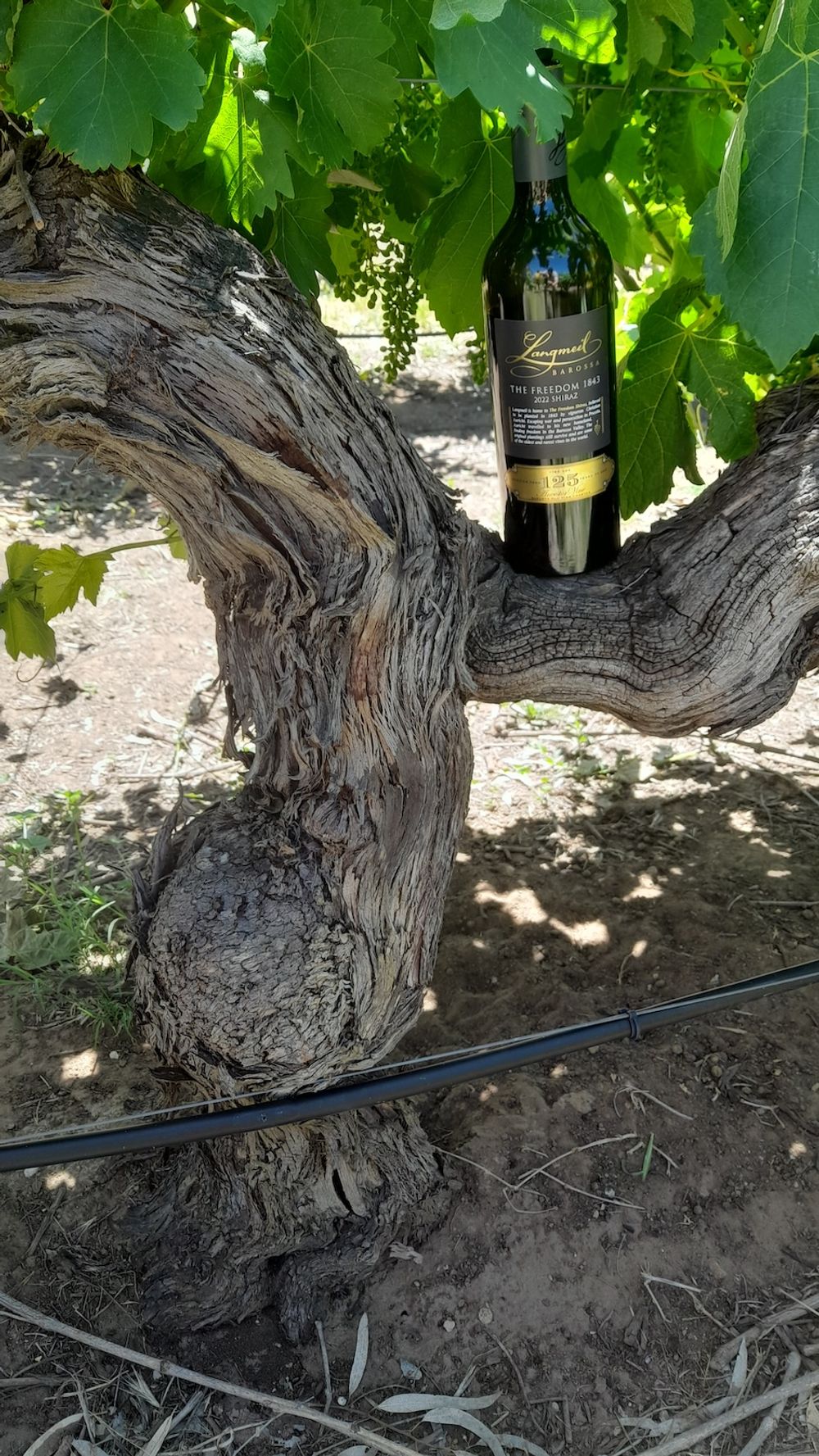
1843 Freedom Shiraz vines
The oldest of them are ten rows of Shiraz, planted in 1843 and covering an acre, at the Langmeil winery on the edge of Tanunda, from which its Freedom Shiraz label is made. The plot, which occupies an acre, has such a low yield that no more than a quarter of a ton of fruit comes off it each year. A few miles away near the town of Nuriootpa, Marco Cirillo has the oldest Grenache and Semillon vines in the world – planted in the year of revolutions in Europe, 1848. Chateau Tanunda’s Grenache vines in the Stonegarden Vineyard in the Eden Valley are almost as old, having been planted in 1858.
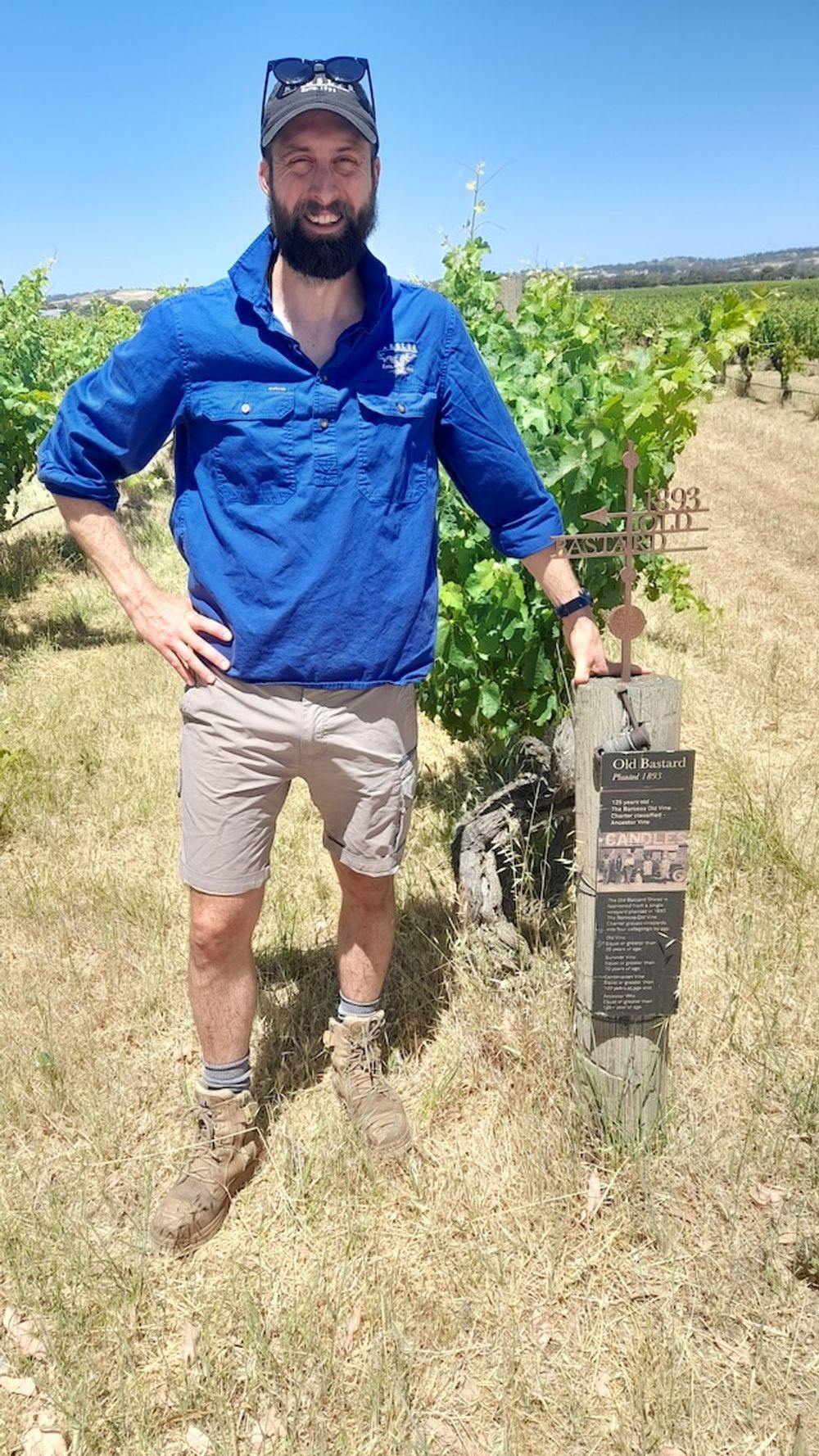
Tim Dolan by Old Bastard 1893 vines
Not too far behind them in terms of age are the oldest vines of Kaesler, named after the Silesian immigrants who settled in the Barossa Valley in 1845. The family planted some Shiraz vines in 1893, and from those 12 surviving and ultra low-yielding rows, the iconic Old Bastard label is still made. While that will set you back close to £100 per bottle, the celebrated Bogan label (made from Shiraz vines plants in 1899 and 1965) is nearer £30.
Senior winemaker Stephen Drew thought the 2021 Bogan was the best vintage he had ever made of it until the 2022 came along. Jeroboams, Kaesler’s UK distributors, received a good allocation of both. “The ’22 had everything to do with the fruit in the vineyard,” Drew told me. “You don’t have that alcohol heat that you had 15 years ago. This beautiful oak tannin/fruit balance – that’s the biggest thing. Sales have been slowly creeping up with Jeroboams since we started with them a couple of years ago. It’s great to have nice growth in the UK as that wasn’t something that was strong before.”
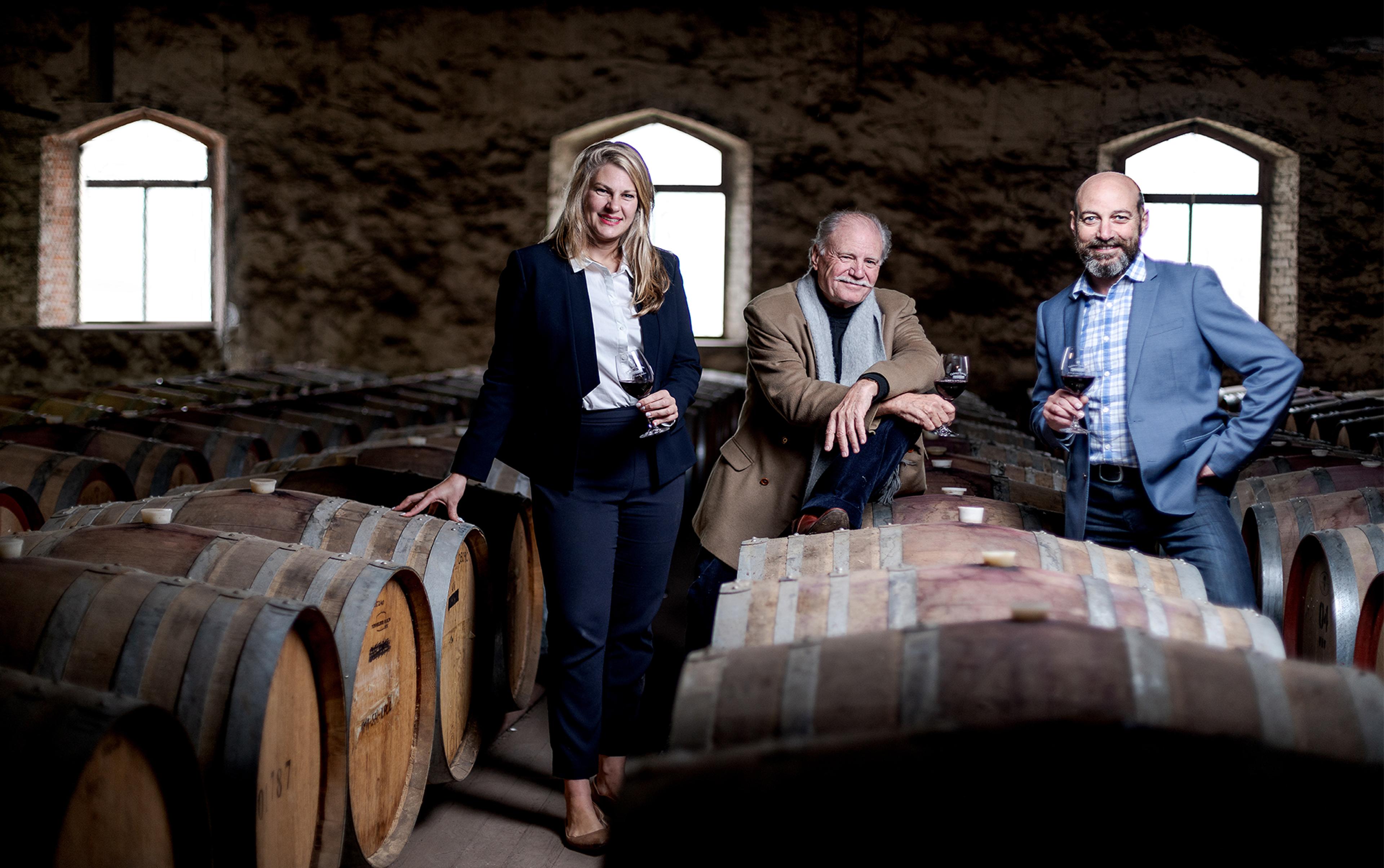
UK sales are also holding up well for another leading Barossa producer, Charles Melton, whose UK distributor is Liberty Wines. While exports used to be as much as 40% of production in the heyday, Charlie, one of Australia’s great winemaking characters, says it is now down to 20%, with 60% of sales direct-to-consumer. He added that his and his daughter Sophie’s approach to vinification has not really changed.
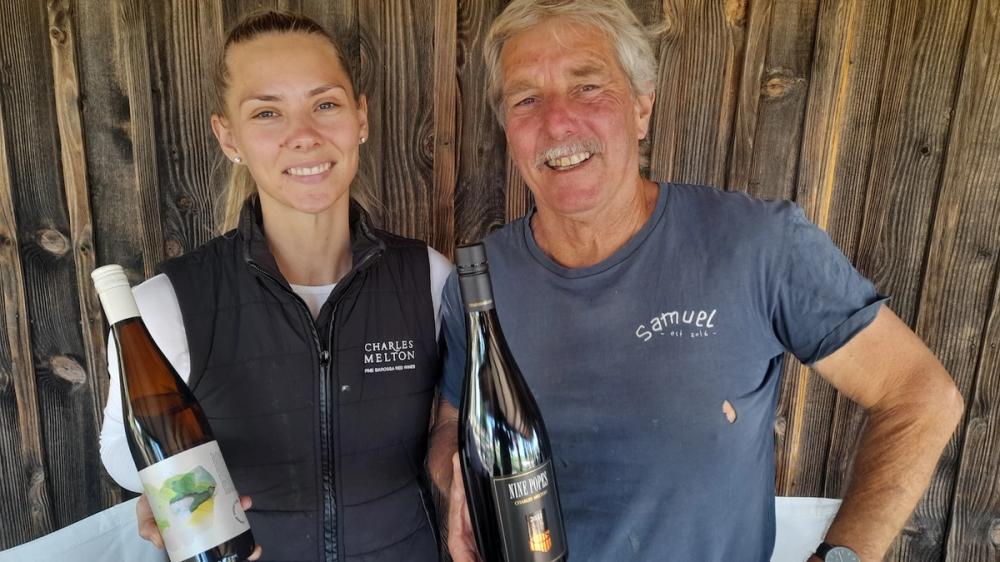
Charlie and Sophie Melton
“Our early Shirazes were 12.5% abv going back to the ‘80s,” he declared. “Like a lot of people, we saw them creep up but we’ve never been part of the Parker phenomenon. So we haven’t changed our style that much. A Barossa red must have generosity, that richness to it. If we start steering away from that, you lose its identity. That generosity is a community thing as the Barossa is a mono-cultural community based around wine. We’re staunch defenders of the Barossa style. We never have a problem getting grapes ripe, so our wines never lack the richness. Mouthfeel is key. All of our sites seem to find that balance of phenolic and physiological ripeness. This year is my 52nd vintage from starting as a cellar rat at Krondorf, and 2025 was the first time we started picking red grapes in January.”
Melton’s Nine Popes label, which celebrates its 40th anniversary this year, is one of the Barossa’s regional classics. As it was named after Châteauneuf-du-Pape, it had to have been a GSM blend, with Melton revealing the Grenache and Syrah comes from vines “nudging 100 years of age.” The blend percentages of 51% and 48% respectively have hardly changed over the years, with a dash of Mataro (as the Aussies know Mourvèdre) adding some spiciness (or ‘seasoning’ in his view).
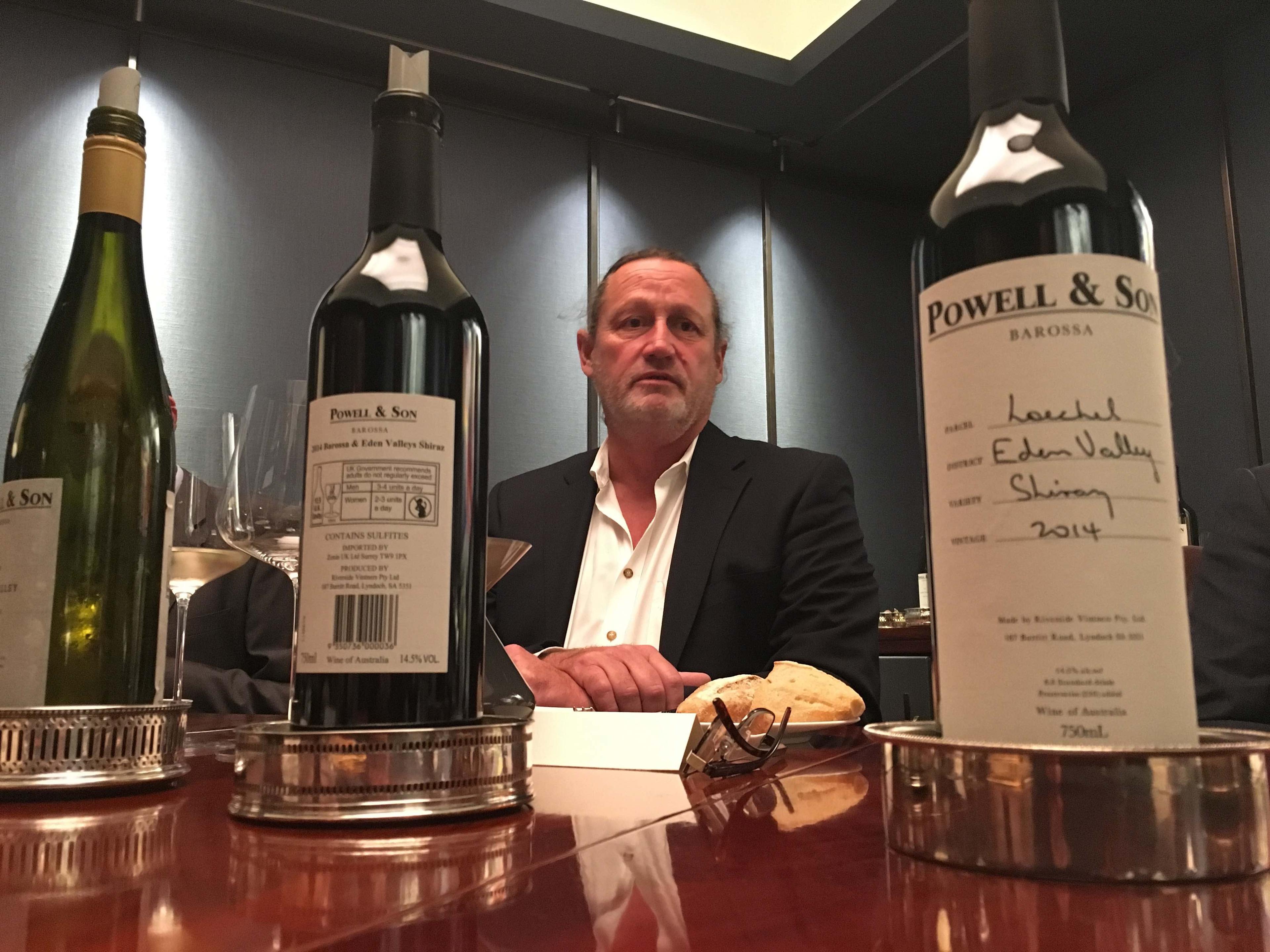
Talking of Grenache, one of the most exciting new developments in the Barossa is at biodynamically-certified Alkina, after Argentinian billionaire, Alejandro Bulgheroni, the owner of Bodega Garzón in Uruguay, bought the Greenock property. Chilean terroir expert, Pedro Parra, was brought on board to carry out the Polygon mapping project to investigate the vine-roots-soil-rock-wine relationship.
“Pedro’s work enables us to understand the location of different patches of geology across our vineyard,” winemaker Amelia Nolan explained. “Pedro refers to these patches of a defined rock and soil type as ‘Polygons.’ Vinifying these Polygons separately allows us to understand our terroir in detail, telling us which areas have the greatest potential on their own, and which are better within a blend.”
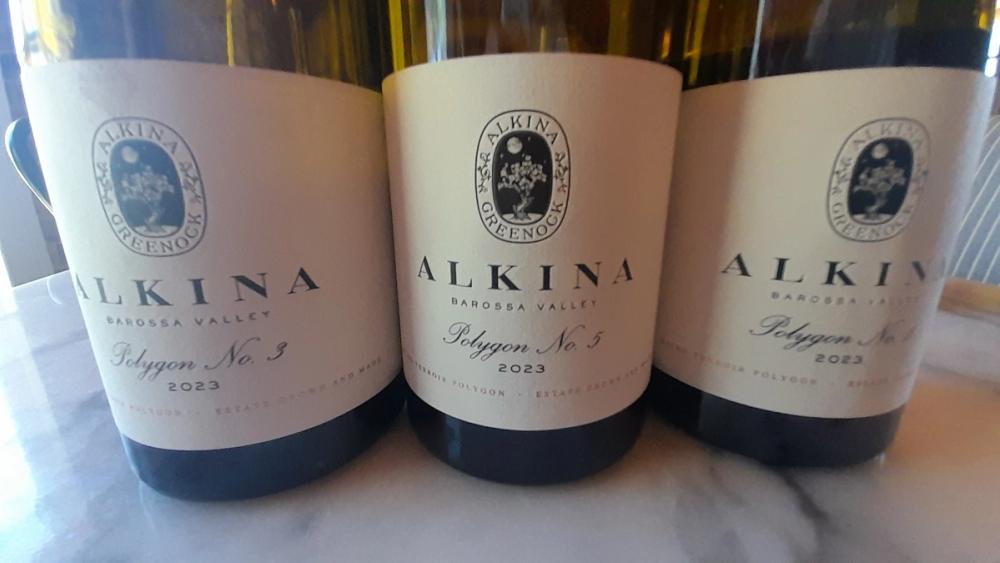
Polygons number 2, 3, 5 and 22 have produced single label Grenache of top quality in 2021, while Polygon No 1 Shiraz 2023 is a stunning release notable for tannin management. “We’re trying to change the perception that the Barossa Valley makes big heavy Shiraz,” Nolan added. Acclaimed international flying winemaker Alberto Antononi is acting as advisory consultant. Flint Wines, meanwhile, is Alkina’s new UK importer.
“True terroir winemaking can be best achieved if the fine vine roots are living in the fractures of the rocks and clay, rather than the topsoil,” Nolan continued. “Access to nutrients and minerals is vastly enhanced by the presence of Arbuscular Mycorrhizal Fungi (AMF), which symbiotically transfer them to fine vine roots. Organic farming allows vines to access a more complex array of ‘food’ via the deeper vine roots and their AMF networks, resulting in more complex, mineral wines.”
Another outstanding biodynamic producer is Kalleske, which was certified as long ago as 1998. Troy Kalleske is the sixth generation member of a family that has been growing grapes on its Greenock property for 170 years. His oldest vines, which date back to 1875, produce his iconic Johann Georg Old Vine Shiraz label, with the 2021 an outstanding vintage. Opulent with masses of black fruit, olive tapenade and dark chocolate, it has superbly managed tannins, great concentration and length. Portal, Dingle & Morris imports Kalleske wines into the UK.
Wendouree
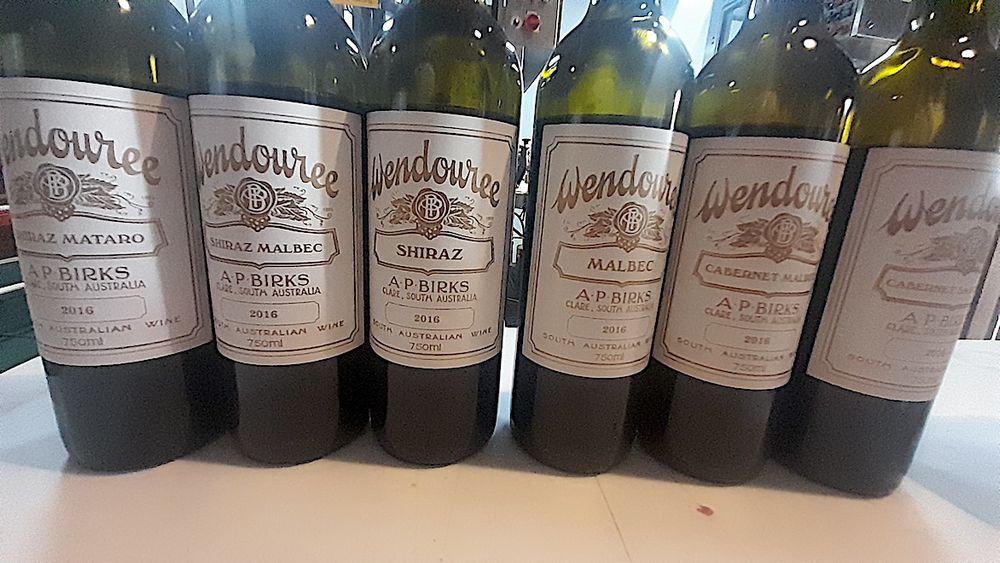
A rare horizontal tasting
Barely an hour’s drive north-west of the Barossa in the Clare Valley can be found yet more 19th century vines. In the same year, 1893, that the Kaeslers planted its Shiraz, the owners of Wendouree were putting in the same varietal into its acidic soils at 450m metres above sea level. Very low pHs for the reds (typically 3.15-3.18) is one of the reasons this revered estate can make such long-lasting red wines in the view of owner-winemaker Tony Brady, who granted The Buyer a rare tasting - a horizontal one of his six red labels from the 2016 vintage.
Brady is very much an old-school winemaker, not possessing a mobile phone and giving social media a wide berth. There is no sign outside the anonymous entrance to Wendouree, which is an old farm gate, and when you wind your way down to the old stone winery which is virtually unchanged from the day it was built over 100 years ago, you think you have come to the wrong place. There is no cellar door as such, and you can’t buy any wine there. All the wines are pre-sold on allocation, and there is a long wait-list for wine club membership, with only 2,000 12-bottle cases made per year.
Wendouree’s other blocks were planted in 1919, 1920, 1929, 1940 and 1970, with Shiraz, Cabernet Sauvignon and Malbec all featuring. These make up some of Australia’s greatest wines, with Brady and wife Lita crafting them with consummate skill and minimal fanfare. Dennis Lillee, the great Australia fast bowler, once came to visit but got badly lost in the surrounding lanes and dirt tracks. When he eventually found his way, he presented the cricket-loving Brady with a photo of his classical bowling action, and asked him if he wanted it signing to him. “No not to me,” replied the modest Brady, “just ‘to Wendouree.’ ” It hangs in the winery.
Another Clare Valley treasure is, however, open to the public - Sevenhill Cellars, which are the oldest of its kind in the region. Founded by a young Jesuit in 1851, and named in honour of the seven hills of Rome, the vineyards were originally established to produce sacramental wine. The buildings were built by the Jesuits from sandstone quarried on the property.
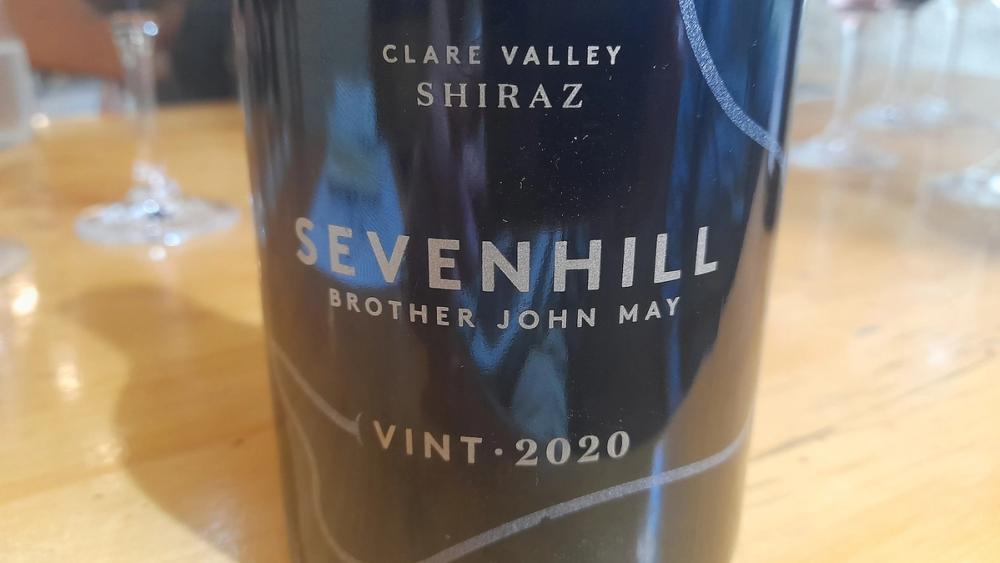
A wide range of impressive wines are sold around the world, with the flagship Brother John May Sevenhill Shiraz label made from vines planted in 1860. The 2020 vintage was fabulously long and intense, with fruitcake, raisin, chocolate and spice notes. Brother John was the last Jesuit winemaker at Sevenhill, working there for 50 years until his death in 2023 aged 93. He is buried in the crypt of the only parish church in Australia to have one – St Aloysius – which, unusually, has no spire. A delightful anomaly in a state whose wine industry is blessed with remarkable historical significance.
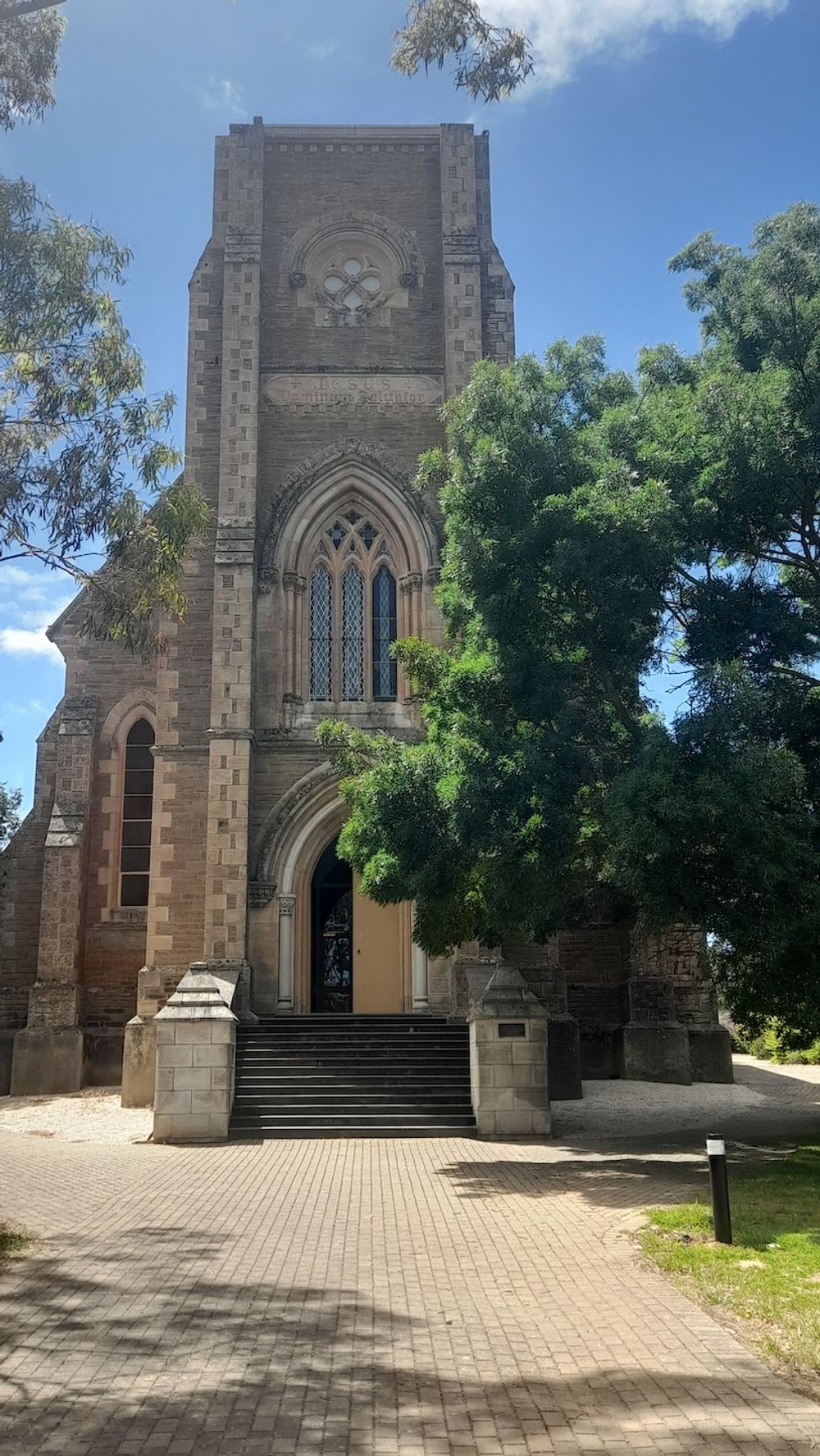
St Aloysius Church, Sevenhill
For more information on wineries in South Australia, visit: www.southaustralia.com"