It’s easy to nod along with the concept of South Africa being a poor country – but putting the concept into cold, hard numbers drives the reality home. The country has among the highest level of income inequality in the world.
Measured by the Gini coefficient, the World Bank puts South Africa at 54.1% (2022, fifth worldwide), while the United Nations University World Institute for Development Economics Research (UNU-WIDER) puts it at 66.99% (2017, taking first place). For reference, the UK’s equivalent figures are 32.4% (2021, World Bank) and 34.24% (2022, UNU-WIDER). Unemployment is over 30%. A recent report by the South African government found that over 37.9% of the population live below the lower-bound poverty line. That equates to roughly 23.2 million people living in poverty – 93.6% of whom are black. There are 10.8 million people living in extreme food poverty. The average income of white households is almost five times higher than that of black African households.
Those aren’t numbers that invite change. But Johan Reyneke isn’t someone happy to accept the status quo.
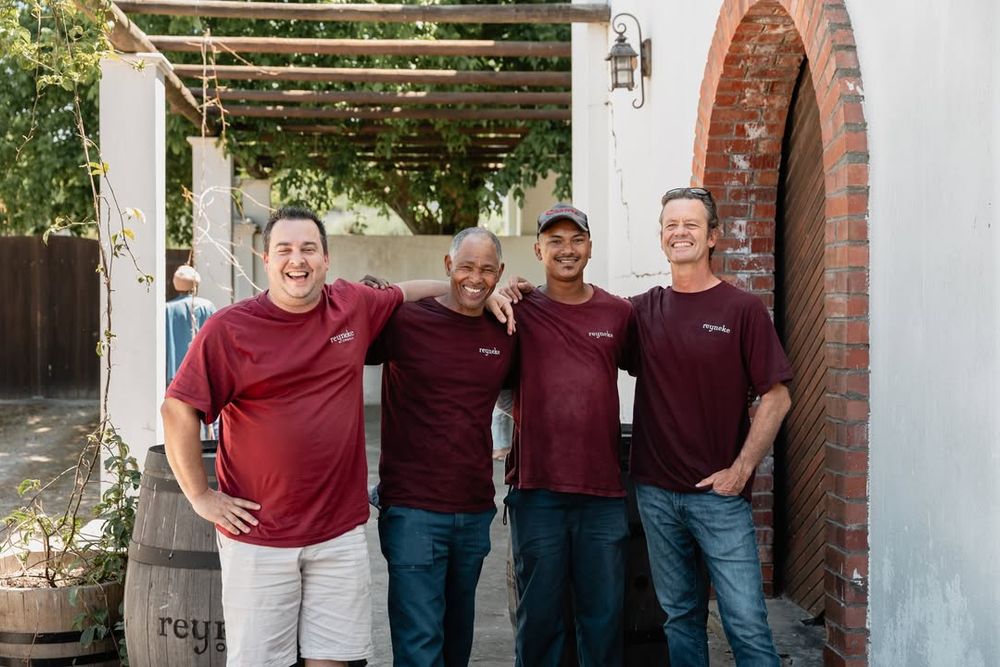
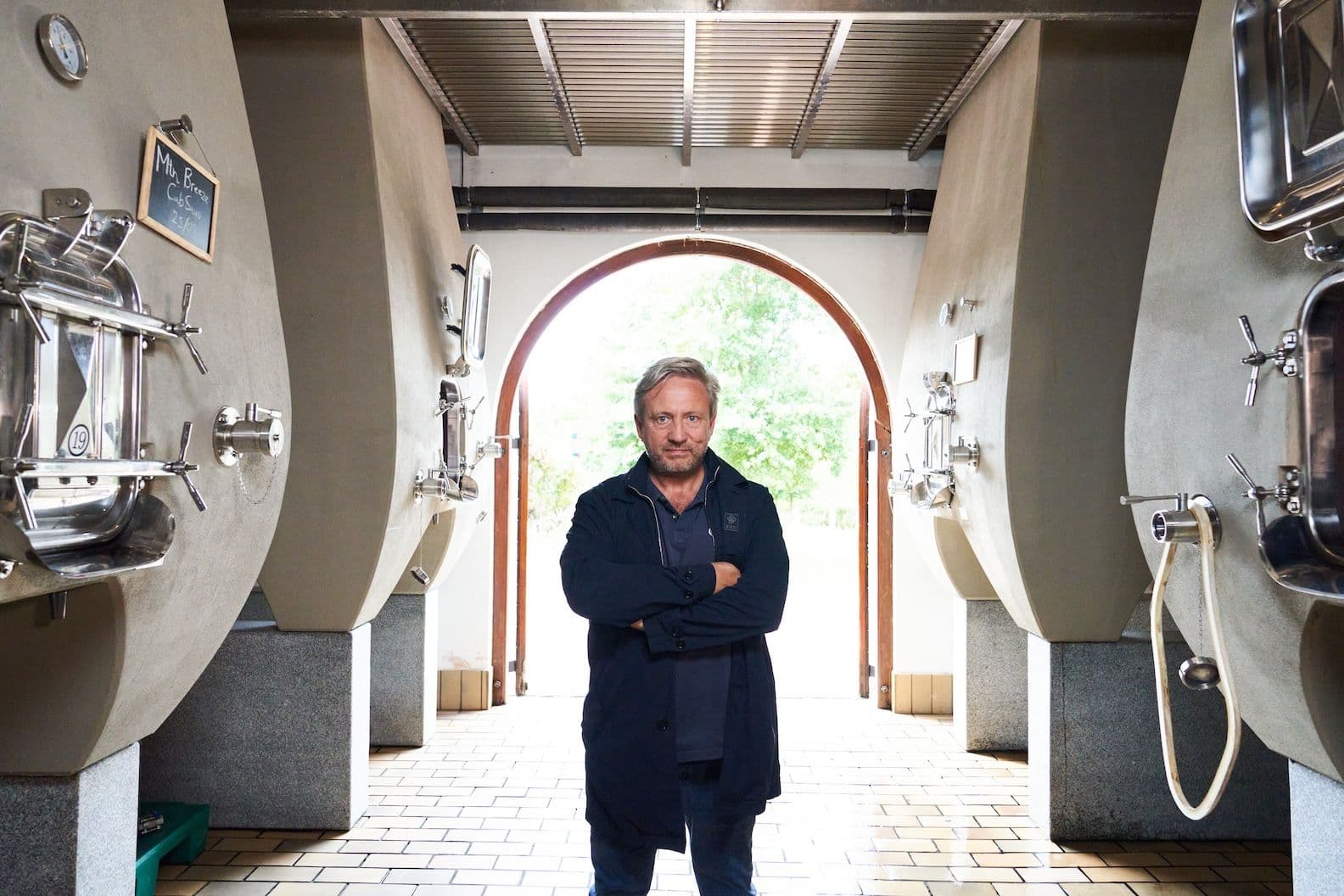
10 years and counting - long-standing Reyneke colleagues Daniel de Klerk, Andre Jacobs, Jerome Pretorius, and Johan Reyneke (l-r)
Sustainability's human dimension
Reyneke grew up in Pretoria, moving to Cape Town aged 10. He studied law at the University of Stellenbosch, then pursued a master’s in philosophy, focusing on environmental ethics, in particular. A hippy with dreads, turned away from corporate jobs, he ended up working as a farm labourer, something that was far from common for a white man in South Africa. One day he and his colleagues were out pruning, and it was bitingly cold. He went home and put on his wetsuit under his clothes; those he was working with didn’t have such a luxury and resorted to newspaper. It was a pivotal moment – one he points to now as the inspiration for his Cornerstone project.
In the late 1990s, Reyneke took over a handful of vineyards (including one owned by his parents – a small parcel that came with the house they bought) and started his farming business. He soon realised he couldn’t make enough money selling grapes, so, he decided to make wine himself – turning the cowshed into a winery. Gradually, he built the farm up to 40 hectares.
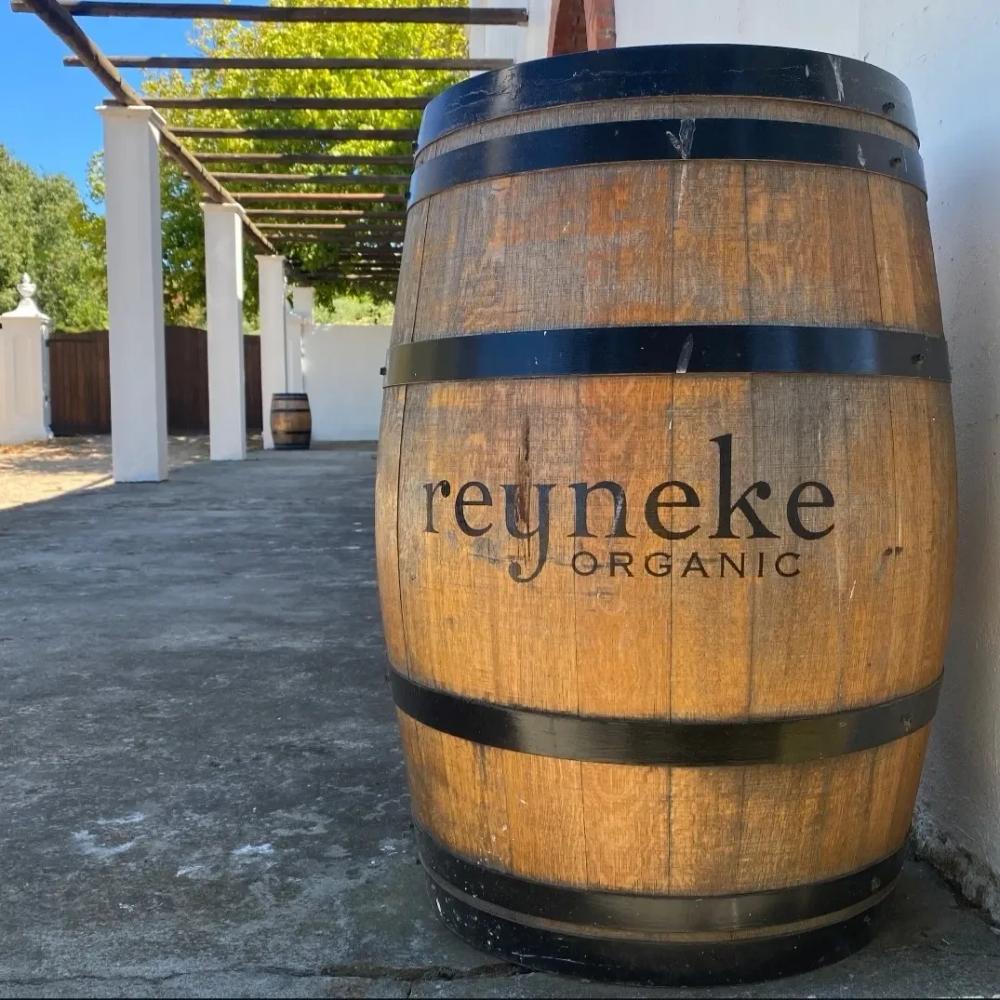
Reyneke became South Africa’s first Demeter-certified wine estate in 2008
The farm sits in the Polkadraai Hills, one of Stellenbosch’s eight wards. To the west of the town of Stellenbosch, with distinctive, decomposed granite soils, this is a cooler side of Stellenbosch producing notably elegant wines. Reyneke’s vineyards reach up to 300 metres above sea level, all south-facing towards False Bay, benefiting from cool sea breezes.
Sustainability has always been at the heart of Reyneke Wines. From 2000, Reyneke farmed organically, then shifting to biodynamic practices, before making it official by becoming South Africa’s first Demeter-certified wine estate in 2008. With active rewilding across the estate and a fully regenerative philosophy, the viticultural – or perhaps more accurately, agricultural – approach is inspiring (read more about Reyneke’s farming here). But Reyneke has always felt that sustainability has three pillars, with the land, or environment, just one of them: human and financial sustainability is just as, if not more important – even if it’s rarely spoken of.
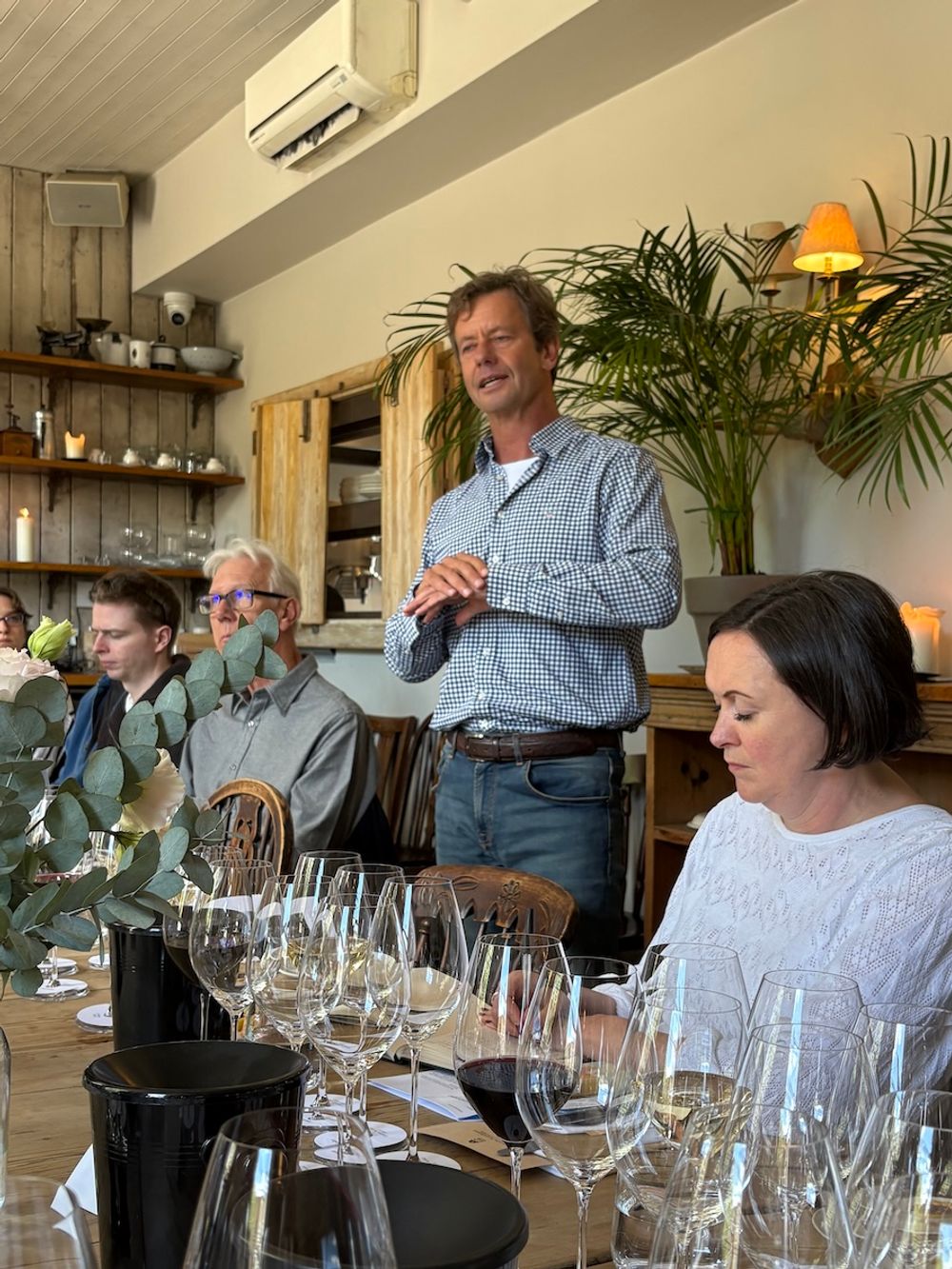
Johan Reyneke at the UK launch of the re-vamped Cornerstone wines
Birth of the Cornerstone project
Talk to Reyneke for any amount of time and he’ll reference Nobel Laureate Amartya Sen, the Indian philosopher who argues that true economic wellbeing is not just about having money but having the freedom to make choices with that money. This concept is at the heart of Cornerstone – the project he started in 2001.
Reyneke made a red wine under the Cornerstone label, the proceeds of which funded the project. Employees – the cornerstone of the business – who work on the farm for 10 years can receive funding, primarily to buy a house, or send a child to university, or to invest, whatever they decide to do with it, all with financial literacy support.
“The bank was very hesitant to support the endeavour,” says Reyneke, “but I was young and rebellious, and I decided to go ahead.” To date, Cornerstone has allowed five families to buy a house, and three people to go to university – one of whom works in their export team today.
Twenty-five years after the project began, however, the business has grown and Reyneke now has another 80 hectares that are gradually being planted. There are more people working at the farm, which means more people who qualify for the Cornerstone fund (eight in the pipeline so far) – but the business can no longer sustain the project alone. A new solution was needed – one that Reyneke hopes can inspire other businesses, one that can “fundamentally change the way business is done.”
He and his team worked alongside the University of Cape Town Graduate School of Business (UCT GSB) and academics at Harvard to build a new model for Cornerstone. The idea is to create an opportunity in the way the value chain works and ensures that consumers don’t pay a premium.
For the new Cornerstone wines, everyone on the value chain can contribute 1% of Cornerstone sales back to the Cornerstone fund – from those supplying dry goods and packaging through to distributors, retailers and bars/restaurants. The contributions are voluntary, and each company can choose to give less, or more, should they wish.
It is, Reyneke admits, risky: “You can cheat the system. There’s a lot of trust involved,” he says. “But if you want to use your business for change, you can.”
The Wine Society and Systembolaget are two of the key players already on board, along with Reyneke’s UK importer New Generation. He plans to launch a dashboard, offering full transparency of the Cornerstone fund – showing how every penny is spent, which anyone contributing will be able to access.
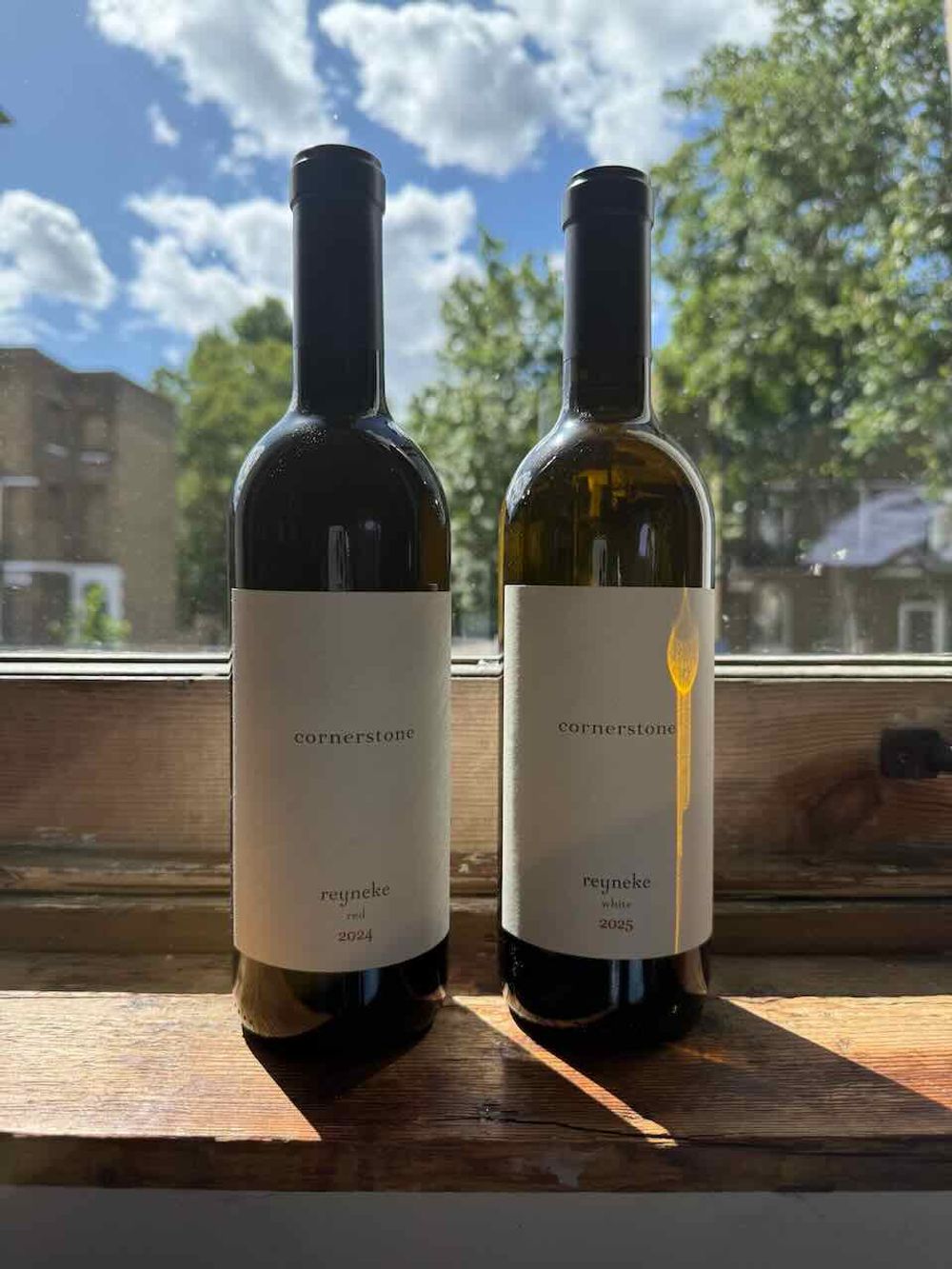
The Cornerstone wines themselves have shifted in time for the relaunch, complementing the updated branding across the range. While Reyneke’s Estate range focuses on individual sites and grapes, Cornerstone, in Reyneke’s words, “reflects the broader philosophy of the farm itself”.
The red used to be a Bordeaux-style blend of Cabernet Sauvignon and Cabernet Franc, but has, as of the 2024 vintage, changed to a blend of Cabernet Sauvignon and Syrah; and there’s now a Cornerstone White, a blend of Sauvignon Blanc, Semillon and Chenin Blanc. They’re beautiful wines, fresh and vibrant, yet layered too, reflecting the quality you expect of the Reyneke name.
For now, the estate is making 2,000 bottles each of the Cornerstone red and white, but once all the vineyards are on stream over the next 10 years, it will have capacity for 25,000 bottles – aiming to grow sales gradually to support the fund.
This project may not transform South Africa’s economic situation – but it’s a step in the right direction, one small effort that may inspire others. For Reyneke, his aim is to show that, “contrary to popular belief, it does pay to do good.” I can only hope he proves it.
Tasting the new Cornerstone Range
Reyneke Cornerstone White 2025
The new white is a blend of 70% Sauvignon Blanc, 24% Semillon and 6% Chenin Blanc, fermented and aged in old oak. The resulting wine has a bright nose, combining luscious grassy notes with honeyed richness. The palate is taut and vibrant with pithy freshness, pure green fruit and a delicious weight, with waxy complexity and a stony mineral note to the long, mouth-watering finish.
Reyneke Cornerstone Red 2024
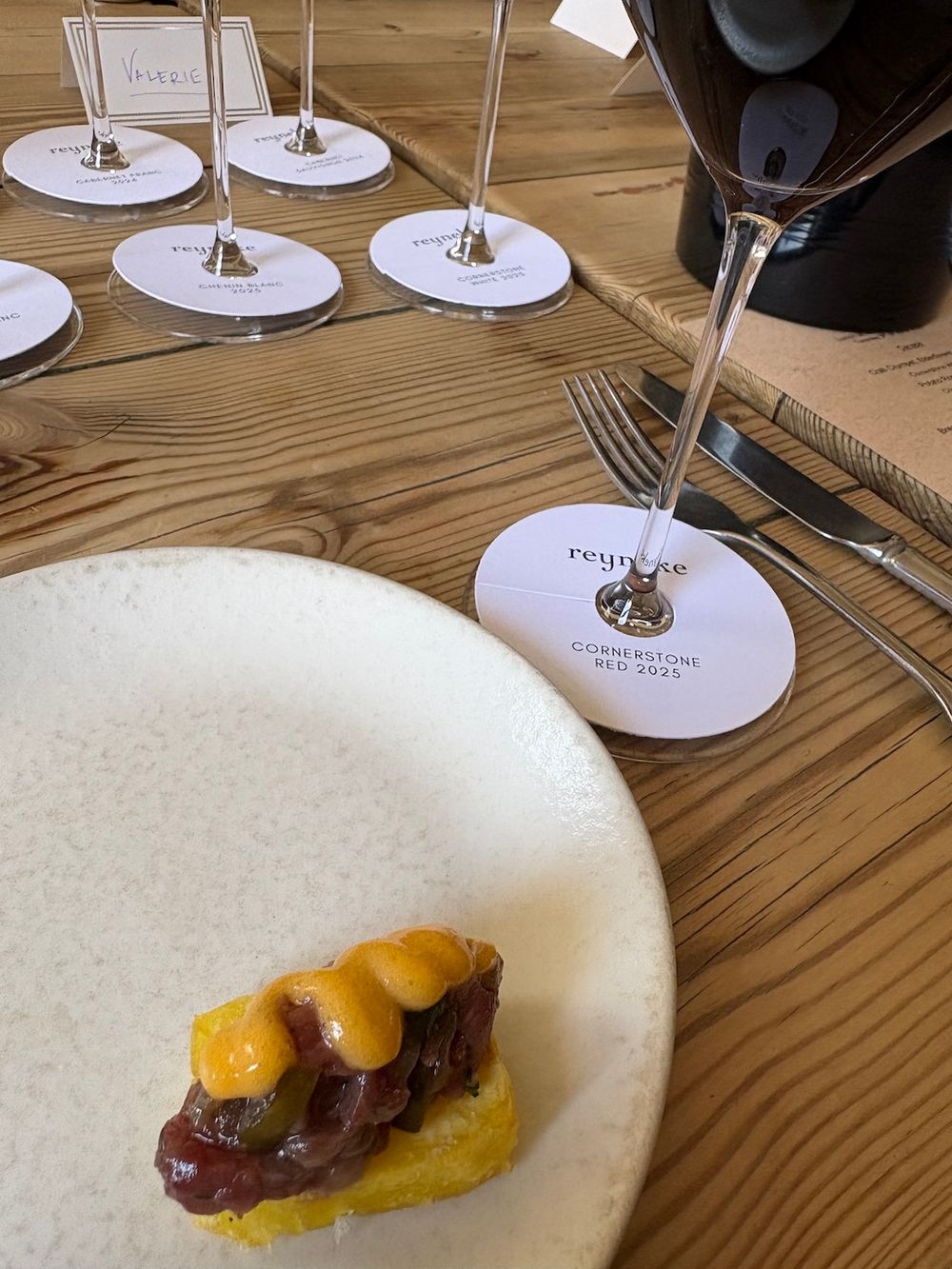
The new Cornerstone red is a blend of 51% Syrah and 49% Cabernet Sauvignon. The Syrah sees 30% whole-bunch, spending 14 months in older oak, while the Cabernet is fully de-stemmed and aged in first-fill oak for 16 months. The nose evolves in the glass beautifully – shifting from muddled bramble fruit and hints of pepper to floral and incense notes. The palate is juicy and lithe, the tannins offering a fine, chalky grip – all the structure there to allow this to age beautifully.
The Cornerstone wines along with the rest of the Reyneke portfolio are available in the UK through New Generation Wines which is a commercial partner of The Buyer.